Why Everything You Made Last Night Sounds Wrong This Morning
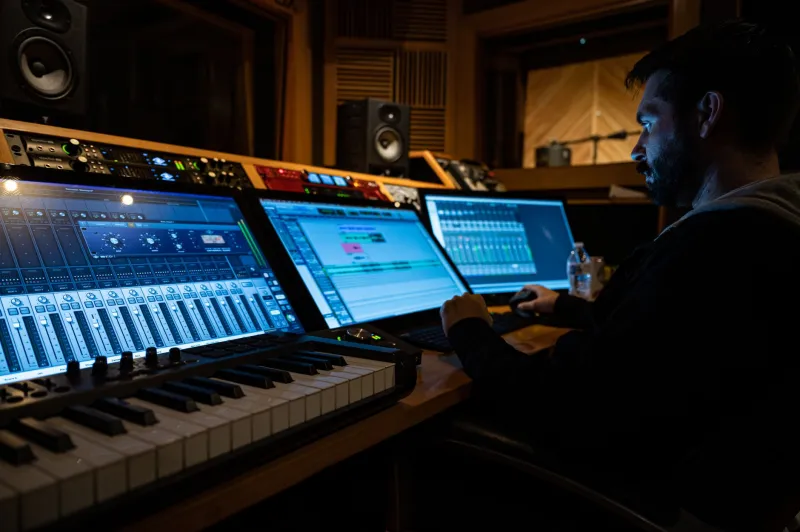
It's a story every producer knows by heart. You're deep in a session, the ideas are flowing, the mix is sitting perfectly, and somewhere around 3 AM you're convinced you've just made something special. You save the project, close your laptop, and drift off to sleep feeling like a genius.
Then morning hits.
You open the session over coffee, hit spacebar, and—wait. The low end is muddy. The snare is buried. That vocal chop you were so proud of sounds weirdly out of tune. What happened between midnight and 8 AM? The short answer: nothing happened to the track. Everything happened to you.
Your Ears Are Not Neutral Instruments
Here's the part most producers skip in their self-education: your ears are organs, not microphones. They get tired. They adapt. And after three or four hours of continuous listening at moderate-to-loud volumes, they start lying to you in very specific, very predictable ways.
The phenomenon is called auditory fatigue, and it's well-documented in hearing science. Prolonged exposure to sound causes the tiny hair cells inside your cochlea to temporarily lose sensitivity—particularly in the upper-mid and high-frequency ranges. That's the 2kHz–8kHz zone, which just so happens to be where presence, clarity, and articulation live in a mix.
When those frequencies start sounding dull to your fatigued ears, your brain compensates. You boost the highs. You add more presence to the snare. You push the vocal forward. Everything feels right in the moment because your ears have recalibrated around their own damage. But when you come back fresh the next morning, those same moves sound harsh, brittle, or just plain wrong.
This isn't a talent problem. It's a physiology problem.
The Room Changes at Night (Even If You Don't)
There's another layer here that doesn't get nearly enough attention: your room sounds different at 3 AM than it does at noon, and it's not subtle.
During the day, ambient noise is everywhere—traffic, HVAC systems, neighbors, people moving around. That background noise, even at low levels, actually affects how you perceive your mix. It acts as a kind of sonic mask, filling in certain frequency gaps and raising your overall perception of loudness. Acousticians refer to this as the noise floor, and it varies significantly across the day.
Late at night, that noise floor drops dramatically. Your room gets quieter than it ever is during waking hours. Suddenly, low-frequency buildup in the corners becomes more obvious. Room modes—those standing waves caused by parallel walls—become more pronounced because there's less competing sound to mask them. The bass frequencies that felt controlled at 11 PM might genuinely be louder relative to everything else at 3 AM, even if you haven't touched a single fader.
The result? You make mixing decisions calibrated to a room that only exists for a few hours a night. Then you wonder why the playback sounds different on your phone, in your car, or anywhere outside that late-night bubble.
The Emotional Variable Nobody Talks About
Beyond the physical stuff, there's a psychological component that's just as real. Late-night sessions carry a particular emotional charge. Fatigue lowers inhibitions. You're less critical, more willing to take risks, and more susceptible to what psychologists sometimes call mood-congruent perception—basically, when you feel good, things sound good.
That euphoric feeling at 3 AM when the beat is knocking? Part of that is genuine creative momentum. But part of it is your tired brain being less equipped to spot problems. You're running on vibes rather than critical listening. And vibes, while essential for creation, are terrible for evaluation.
This doesn't mean late-night sessions are bad. Some of the most instinctive, emotionally resonant music gets made in those hours precisely because the internal critic goes quiet. The mistake is treating late-night evaluation as reliable.
Building a System That Accounts for All of This
The goal isn't to kill the 3 AM session—it's to stop letting 3 AM you make permanent decisions that 8 AM you has to live with.
Capture, don't commit. When you're in the zone late at night, your job is to capture ideas, not finalize them. Bounce a rough mix to your phone. Voice-memo yourself explaining what you were going for. Screenshot your plugin settings. Document the vision so that when you come back fresh, you're not starting from scratch—you're editing with context.
Set a hard rule: no export after midnight. This sounds simple, but it's one of the most practical things you can implement. Finishing a session and sending out stems, uploading a release, or sharing a mix when your ears are fried is how avoidable mistakes get made at scale. The track will still be there in the morning.
Use reference tracks consistently. A-B comparison against a commercial reference you know well is one of the fastest ways to reality-check your ears at any hour. If your mix starts sounding better than your reference at 2 AM, that's usually a red flag, not a milestone.
Take mandatory breaks every 90 minutes. Step away from the monitors, go outside if you can, let your ears reset. Even 15 minutes of silence does measurable work in reducing fatigue. Some producers swear by a 5-minute walk between major mix decisions—it sounds excessive until you realize how often it changes what you hear when you come back.
Do your critical listening at a consistent time of day. If you want to evaluate a mix accurately, do it when your room is at its normal noise floor and your ears are fresh—ideally in the morning before you've been listening to anything else. Make that your evaluation window and protect it.
The Takeaway: Trust the Process, Not the Moment
The 3 AM session is sacred. It's where a lot of real music gets born—the uninhibited stuff, the risky ideas, the sounds that wouldn't have happened if you were thinking too clearly. None of that changes.
But there's a difference between making music and judging music, and collapsing those two things into the same late-night haze is where producers consistently trip themselves up. Your creative instincts at midnight can be brilliant. Your critical judgment at 3 AM is almost always compromised.
Build a workflow that honors both. Capture everything. Commit to nothing. Come back with fresh ears and let the morning version of you be the one who decides what actually made the cut.
The track isn't going anywhere. Neither is your talent. Give them both the conditions they deserve.